Smart Power Electronics
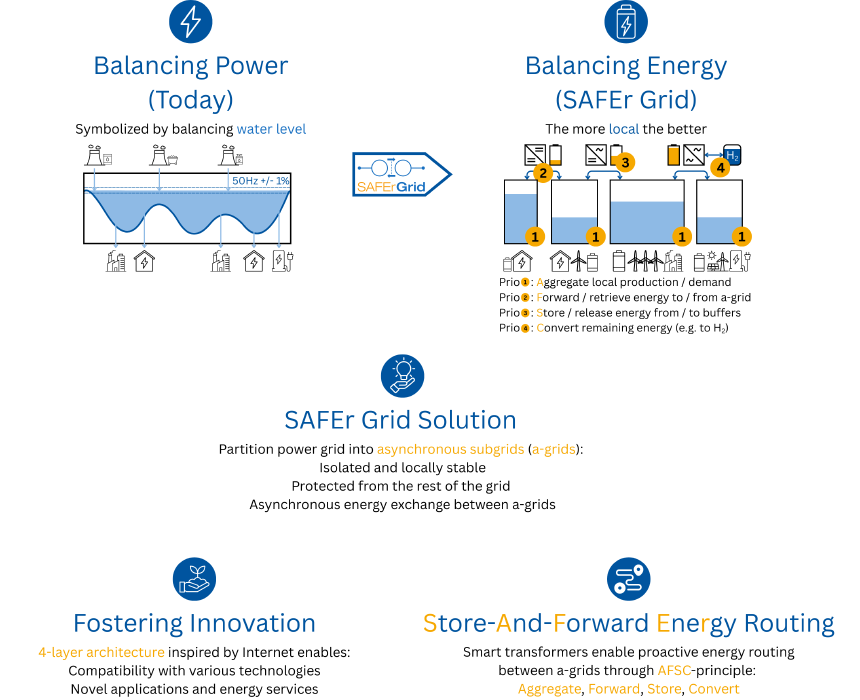
High-frequency, programmable power electronic converters are the physical core of the envisioned energy router devices that decouple a-grids and enable bidirectional AC–DC–AC and/or DC–DC conversion across arbitrary voltages and frequencies. Also known as smart transformers, they allow store-and-forward energy routing, turning passive power flows into controllable energy streams.
Energy Buffers and Storage
The rollout and increasing availability of stationary battery storage systems and other multi-energy-carrier storage provide the energy buffers needed to perform store-and-forward energy routing and to smooth intermittency by decoupling energy production and consumption in time. This is formalized via the so-called AFSC priorities (Aggregate–Forward–Store–Convert), where energy buffers and storage is only used when local balancing and forwarding are infeasible.
Fast and Reliable Communication
A dedicated cyber layer leverages fast and reliable communication solutions for exchanging energy commands, status information, and flexibility offers between a-grids and energy routers. This digital nervous system can replace global frequency as the dominant coordination signal and enables asynchronous, event-driven routing and balancing of energy among a-grids.
Asynchronous Power System Dynamics Theory
New modelling and stability frameworks are required that do not assume global frequency synchronism. This includes Lyapunov-based stability analysis, impedance and harmonic methods, action energy, and energy-shaping port-Hamiltonian models that describe physical systems in terms of energy storage, dissipation, and exchange. These approaches underpin the design and verification of store-and-forward energy routing between a-grids under realistic scenarios and assumptions.
Cyber–physical Systems Theory and Modeling
The consideration of asynchronous power grids as a cyber–physical system of systems requires new theoretical and modeling frameworks that integrate the coupling of continuous power dynamics with discrete communication/control events. Cyber–physical systems theory is thus essential for designing coordination mechanisms that can reliably route energy between a-grids while guaranteeing stability and resilience to faults and critical events.
Internet-inspired Abstraction Principles
Internet-inspired abstraction principles, i.e., a layered architecture separating a-grid physics, energy routing, energy streaming, and applications, allows asynchronous power systems to scale while keeping the core simple and stable. This separation lets technologies and applications evolve independently over time without repeatedly redesigning the core energy routing and balancing mechanisms.